AdamSofi AI Office
One instruction. The right work, in order.
A private operations desk where one written instruction is planned, split across specialist agents and run in the background. Every result stops at a human approval before it leaves the building - nothing is sent, published or merged on its own.
- Type
- Internal system
- Status
- Live
- Category
- AI & automation
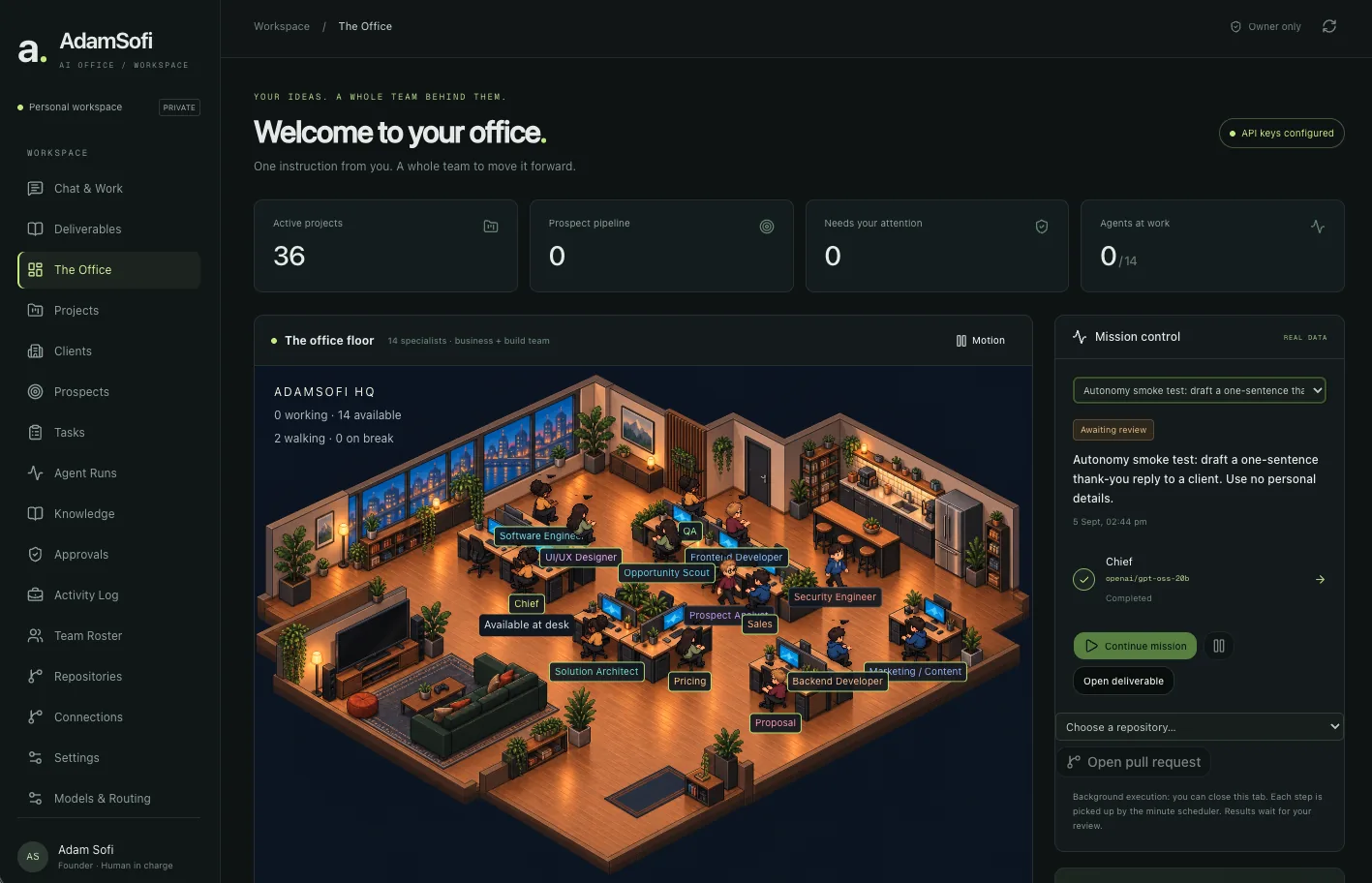
Most AI tooling fails in one of two directions: it does too little to be worth opening, or it acts on its own and has to be undone. This is an attempt at the space between.
Key features
- One instruction becomes a plan across specialist agents
- Runs in the background, with pause, retry and resume
- Clients, projects, tasks and approvals in the same workspace
- Every outbound action waits for a human decision
The situation
Running client work alone means the same shape of work repeats constantly: read what came in, decide what it needs, break it into steps, do the steps in the right order, and make sure nothing is sent before it has been looked at.
The middle of that - the planning and sequencing - is mechanical. The ends are not. Deciding what matters and approving what goes out are judgement, and handing either to a model is how people end up cleaning up after their own tools.
So the question was not "can AI do this work". It was "which parts of it should a person still be holding".
What was built
One instruction becomes a plan
A written instruction is turned into an ordered plan and split across specialist agents, rather than handed whole to one generalist that does all of it adequately and none of it well.
It runs in the background
Work continues without the window open, and can be paused, retried and resumed. A long job that fails at step six does not start again at step one.
Clients, projects, tasks and approvals in one workspace
The work and the record of the work live together. There is no separate place where the real status is kept.
An approval gate on every outbound action
Anything that sends, publishes, spends or merges stops and waits for a person. Not as a setting that can be switched off - as the way the system is built.
Why it was built this way
The human gate is architecture, not a preference
If approval is a toggle, it gets switched off on the day someone is in a hurry, and that is precisely the day it was needed. Building the stop into the path an action must take means the safe behaviour is the default behaviour, permanently.
Specialists over one generalist
A single agent asked to do everything produces work that is uniformly acceptable. Splitting by kind of work - and giving each part only the context it needs - produces results that are better and easier to check, because a wrong step is visible as a wrong step rather than buried in a long answer.
Resumable by default
Long-running work fails partway. Treating that as normal rather than exceptional is the difference between a tool that is used daily and one that is abandoned after the second time it loses an hour of work.
Built in-house first
This runs my own work before it is offered to anyone else. It is the honest way to find out which parts genuinely save time and which only look good in a demo.
Where it stands
Private, and used internally. There is no public URL, and the screenshots on this site are the system as it actually runs rather than a mock-up made for the portfolio.
Related projects
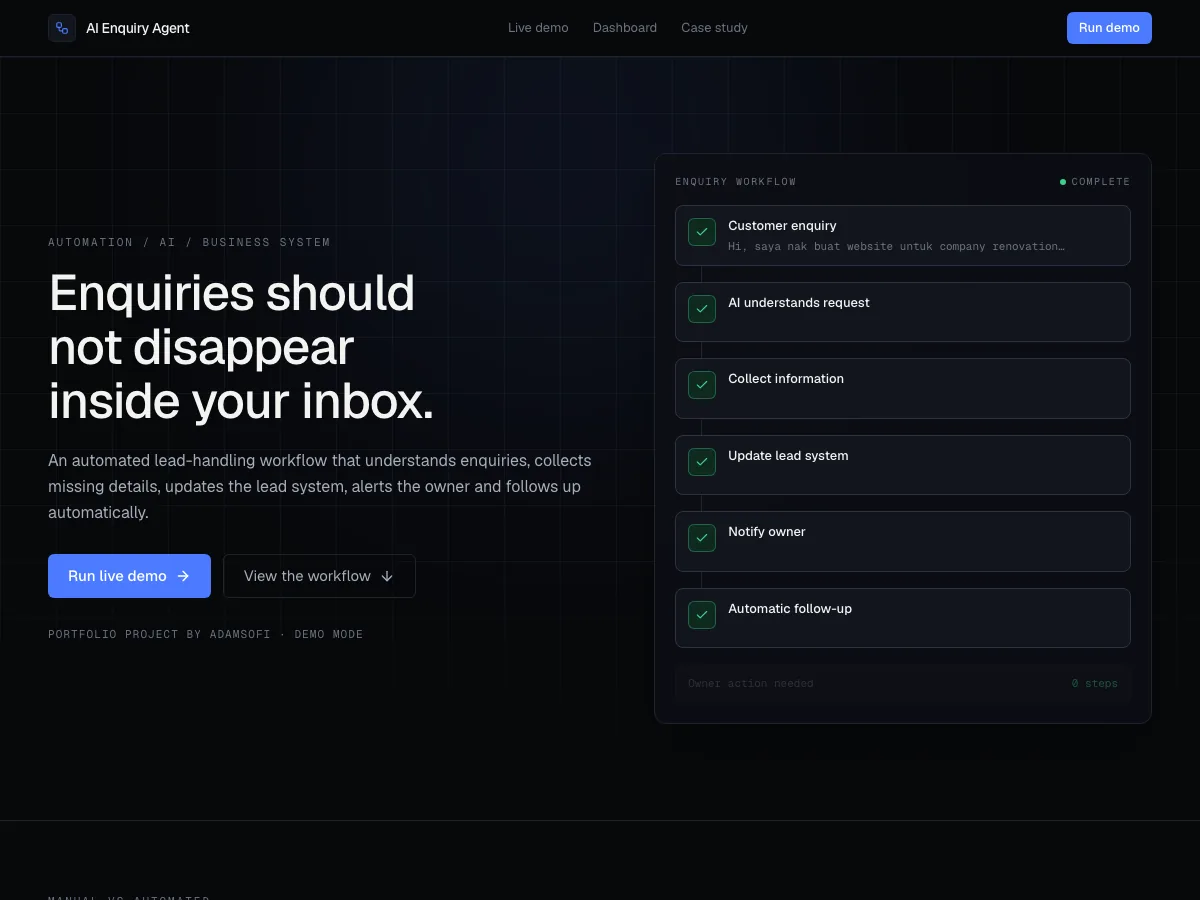
Enquiry Agent
An AI-powered enquiry workflow that understands incoming requests, collects the right details and routes each lead to the next action.