Enquiry Agent
Every enquiry gets a useful next step.
An AI-powered enquiry workflow that understands incoming requests, collects the right details and routes each lead to the next action.
- Type
- Demo
- Status
- Demo
- Category
- AI & automation
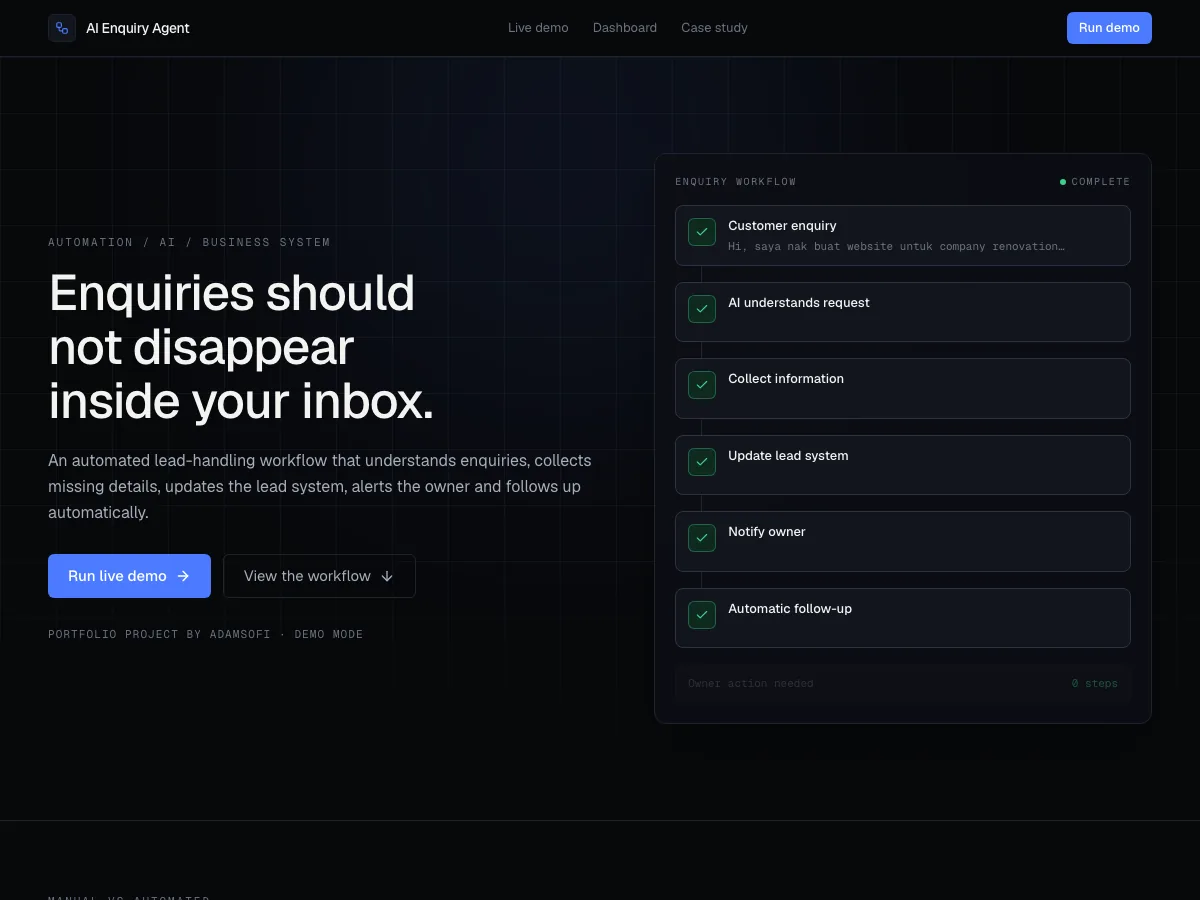
Businesses rarely lose customers at the sale. They lose them in the gap between an enquiry arriving and someone getting to it.
Key features
- Understands customer enquiries
- Collects key information
- Routes follow-up actions automatically
The situation
An enquiry arrives at 9pm on a Saturday. It is read on a phone, in a queue, or between two other things. By the time anyone is at a desk it is Monday, it is under four other messages, and the person who sent it has already asked someone else.
The work of handling it is not hard. It is reading what they want, working out whether it is worth the time, asking for the details they did not include, and writing a reply. It is just that all of it has to happen quickly, and it competes with the actual work of the business.
The usual fix is an auto-responder, which everyone can tell is an auto-responder, and which collects nothing useful.
What was built
It reads the enquiry properly
What the person wants, and how urgent it is - worked out before anyone opens it, so the first human look already has context attached.
It collects what is missing
The questions you would have asked anyway, asked immediately. The first real reply is an answer, not a request for more information.
It scores and routes
Enquiries are not equal, and treating them as one queue means the good ones wait behind the rest. Each is scored and sent to the right next action.
It drafts, and then stops
A reply is written and left waiting for approval. The person’s job becomes reading and sending rather than starting from a blank message.
Why it was built this way
Draft, never send
An automated reply that goes out on its own will eventually go out wrong, to the wrong person, at the worst time - and the damage is to the business relationship, not the software. Drafting removes almost all of the work and keeps the judgement where it belongs.
Score before routing, not after
Routing everything to one inbox and sorting it by hand is the manual process with extra steps. The decision about what matters has to happen before a human is involved, or nothing has actually been saved.
Channel-agnostic intake
Enquiries arrive from a website form, WhatsApp, or wherever the customer already is. Building around one channel means rebuilding it when the business adds another.
Follow-up is the feature
Most work is lost on the second and third touch, not the first. The part that keeps going when everyone is busy is the part worth automating.
Where it stands
A working public demo, built to show the shape of the workflow rather than to serve a specific business. A real deployment is fitted to the channels and the decision rules of the business it runs for.
Related projects
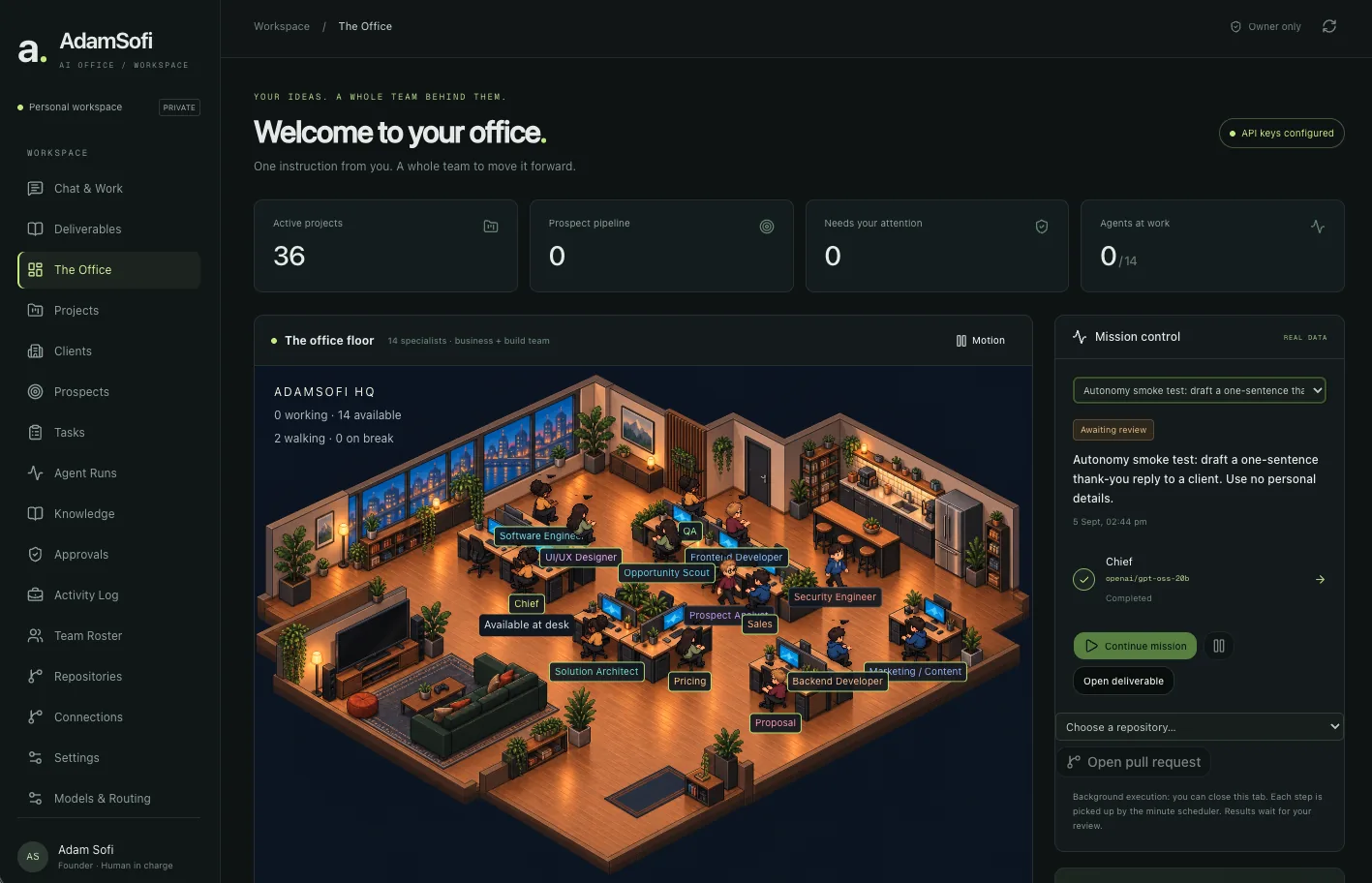
AdamSofi AI Office
A private operations desk where one written instruction is planned, split across specialist agents and run in the background. Every result stops at a human approval before it leaves the building - nothing is sent, published or merged on its own.